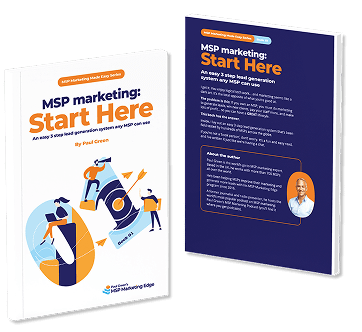
Get a free MP3 of my book MSP marketing: Start Here
when you join 8,000 other MSPs getting my weekly newsletter
A brutal truth... if buyers can’t quickly understand who you help and why you’re different, they won’t choose you. Here's how to fix that
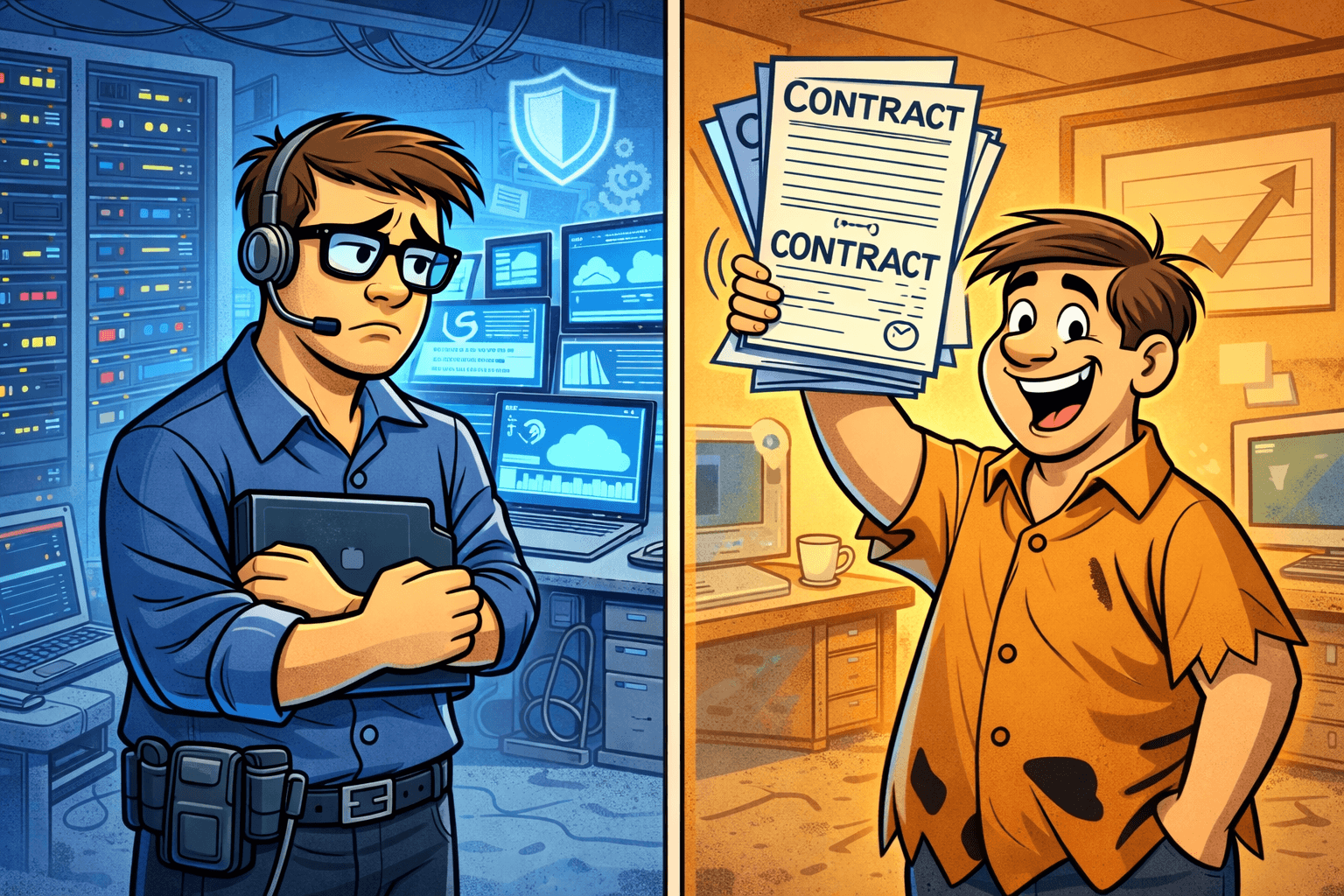
Let me start with something that might feel a little uncomfortable, but it’s really important to say it out loud. Technically, you are probably better than some of your competitors.
Do you agree with that?
Maybe your tech stack is stronger. Or your people are more capable. Or your systems and procedures are more robust.
And yet, despite that, every day local businesses still choose another MSP instead of you (unless you are getting 3-4 meeting requests a day, that's definitely the case).
BUT WHY??????????
How come they're picking MSPs that aren't as good as you? What's wrong with them?
Most MSPs assume that if they just keep improving the service, the results will follow.
Better tools + processes + delivery = more clients.
And while those things absolutely matter, the reality is they don’t solve the problem that’s actually costing you deals.
Because the issue usually isn’t effort, or quality, or commitment. It’s how buyers perceive you.
To an ordinary business owner or manager (someone who doesn’t live in our world) most MSPs look broadly the same.
That’s not an insult! It’s just how human decision-making works when someone is buying something they don’t fully understand.
When a business owner starts thinking about switching IT support, they go into research mode. They Google a bit, do some AI research and skim a few websites. Some LinkedIn profiles too. They shortlist and compare 2-3 providers.
From their point of view, this is not easy. Because the messaging looks and feels the same everywhere they look. MSPs using the same kinds of messaging... I'm talking themes such as:
Proactive. Secure. Responsive. Reliable. Great service. Trusted partner.
None of that is wrong. But none of it helps them to choose.
And when buyers can’t clearly see a difference between options, they default to one of two things:
- Picking on price, or
- Doing nothing at all
Neither outcome works in your favour.
This is why samey kills sales, even for technically excellent MSPs.
What’s happening is that many MSPs accidentally position themselves as just another option.
Not because they lack expertise, but because they explain their business from THEIR perspective, not the buyer’s.
- Features instead of outcomes
- Process rather than reassurance
- Technical competence instead of clarity
The result is that your average competitors often win deals, simply because they feel easier for the layperson to understand and therefore easier to choose.
That’s the key shift most MSPs never make. It’s a positioning problem.
If a buyer can’t quickly answer three basic questions:
- Who you help
- What outcome you deliver, and
- Why you’re different
They won’t choose you. Not because they dislike you, but because their heart can't differentiate you, meaning their brain can’t justify picking you.
THE ANSWER: You need a USP, also known as a Unique Selling Proposition.
A real USP isn’t a slogan or a clever line of copy. It’s the foundation that makes everything else work. It’s what turns your website, your LinkedIn and your sales conversations into something coherent and totally different, instead of interchangeable.
Here’s a simple way to pressure test this.
Ask your AI tool of choice to look at your website and those of 3-5 competitors. Then ask it this question: “From the point of view of a stressed business owner who doesn’t understand IT, how different do these MSPs sound from one another?”
If the answer is “not very”, that’s not a failure. It’s a blind spot. And it’s one that almost every MSP has at some point.
Strong positioning usually anchors around something specific and deliberate. It might be the outcome you deliver, the sector you specialise in, a category you consciously own, the value buyers care about most, or even the human personality behind the business. What matters is that it gives buyers something clear to latch onto.
Most MSPs know this, at least intellectually. Far fewer actually act on it in a structured way.
A good USP is made up of three components:
- Core positioning statement (examples below)
- Strapline / headline
- 60 second elevator pitch
You can't start work on the strapline and pitch until you are 100% sure of your core positioning. Think of this as an internal document that guides all your marketing.
Here's a core positioning format that works well for MSPs...
We help [ideal client] achieve [desired outcome] by [your differentiator or unique strength]
And some real life examples:
- We help law firms stay compliant and interruption-free by giving them proactive IT that’s built specifically for legal workflows
- We help manufacturers maximise uptime by providing IT support that understands the realities of production environments
- We help business owners stop worrying about their technology by giving them a highly personal, human-led IT partnership
Can you see the power of having this figured out? And how much easier it will be to change the positioning on your website, LinkedIn and across all your marketing once you have this clarity?
Get a free MP3 of my book MSP marketing: Start Here
when you join 8,000 other MSPs getting my weekly newsletter
Buy it now on Audible.
Or in the next few minutes when you start getting my email newsletter.
Discover the marketing used by successful MSPs to generate leads & win clients