Paul Green
/
April 28, 2026
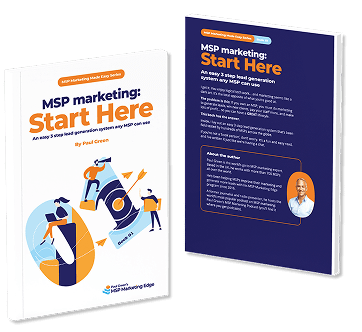
Get a free MP3 of my book MSP marketing: Start Here
when you join 8,000 other MSPs getting my weekly newsletter
Every MSP I know who hires someone into this role sees an immediate jump in perceived customer service levels
Close your eyes for a few moments and imagine you work for one of your clients.
In fact, pick a client in your mind right now. It could be your favourite client or just one of your everyday clients. This will just help you visualise what I'm about to talk about.
So you're one of the team working for one of your clients. And something's gone wrong with your laptop. It’s not catastrophic, but it’s annoying. And you really need it sorted as it's impacting your work.
You log a ticket with "the IT support people" (that's your MSP). An auto-response pings back. And then...
Nothing.
Radio silence.
Maybe a brief message a few hours later. Maybe not even that.
You’re left wondering: has anyone actually seen this? Is anyone working on it? Should I chase?
That experience... the silence... is one of the biggest reasons clients quietly start to lose confidence in their MSP. Not because problems don’t get fixed. But because the communications around the problem fixing is so poor that people get frustrated.
You and I know that in the background a technician could be working really hard on that issue. If the person who reported the problem doesn't know that and doesn't have the confidence that their problem is a priority (even if actually it's not), then unhappiness starts to set in.
Good news: There’s a role that fixes this problem. And most MSPs don’t have anyone in this role, which is a huge opportunity for you.
This is why you might choose to hire a dispatcher.
What a dispatcher actually does
A dispatcher sits between your clients and your technicians. It's not a technical role. Their job isn’t to fix stuff. It’s to own the communications and customer service.
Every single ticket that comes in gets an immediate proactive phone call. The dispatcher acknowledges the problem, asks a couple of follow-up questions if needed, and empathises with the user.
“This is a really annoying one, isn’t it? I’m going to get one of our senior technicians onto this straight away, and you’ll have an update within the hour.”
That’s it. That’s the call. Two minutes, maybe three.
But notice what just happened. The person with the problem feels heard. Their anxiety has dropped.
And what's really cool is the dispatcher has just bought the technicians plenty of time to look at the problem without being chased.
Many problems can be fixed really quickly. The time delay is because they're low down the priority list, right? When the dispatcher communicates properly, you're buying time for the problem to work its way up the queue.
From a client’s point of view, good communication matters far more than whether the ticket is resolved in five minutes or 55. When people know there’s a calm, organised human being on the other end, everything feels different.
The operational benefits are significant too
The client experience improvement alone would justify this hire. But there’s more.
Without a dispatcher, your technicians are constantly context-switching. Answering phones. Checking queues. Deciding what to prioritise. Responding to interruptions. All of that is expensive time that isn’t being spent fixing things.
A dispatcher typically works alongside a service desk manager and routes tickets properly. Makes sure the right work goes to the right technician. Sets priorities logically rather than emotionally. And protects your techs so they can actually get into flow and do their best work.
Here’s the commercial bit that delights most MSP owners: Because they are not in a technical role, a dispatcher typically costs significantly less than a technician. And by freeing up technician capacity, you can delay or completely avoid hiring another tech. That’s a meaningful saving.
Which means that a dispatcher isn’t overhead. They’re leverage.
And here’s the part most MSPs get wrong
They assume a dispatcher needs to be technical.
They don’t. In fact, some of the best dispatchers come from completely outside IT.
Think about the skills this role actually needs:
- Juggling priorities
- Managing expectations
- Staying calm under pressure
- Communicating clearly
- And still being warm, smiley and reassuring while doing all of this
Who already has those skills? Someone who’s run a busy coffee shop. A hotel receptionist. Someone who’s worked on the front desk of a car service department.
These people deal with stressed, impatient customers every single day. They know how to hold things together when everything’s kicking off.
You can teach systems and processes. What’s almost impossible to teach is empathy, organisation, and the ability to stay cheerful when someone’s shouting at you.
Hire for those qualities. Train the rest.
What changes when you get this right
Every person who works at every client gets acknowledged quickly. Nobody's left wondering whether anyone’s seen their request. Clients are kept informed when there’s a delay. And your technicians can concentrate on the work that only they can do.
Over time, the dispatcher becomes the friendly, consistent face of your service desk. The person clients recognise. The person your clients' staff trust. And when that happens, everything gets easier.
Most MSPs reach a point where the biggest challenge becomes customer service rather than capacity. A dispatcher can be the single hire that fixes that gap faster than anything else.
Question: Do you have a dispatcher?
Or is this a role you’ve been doing without... and quietly feeling the consequences of?
Let me know. I’d love to hear whether you have this role in place, what it’s changed for you... OR what’s stopped you hiring for it. I read and reply to every email.
Get a free MP3 of my book MSP marketing: Start Here
when you join 8,000 other MSPs getting my weekly newsletter
Inside, I’ll reveal the four biggest obstacles blocking your lead generation and the simple 3 step system that overcomes them.
Buy it now on Audible.
Or in the next few minutes when you start getting my email newsletter.
Discover the marketing used by successful MSPs to generate leads & win clients
Every week I send out a FREE 5 min MSP marketing win. Smart ideas used by hundreds of MSPs to generate leads and close prospects.
Sent weekly on Fridays. Unsubscribe any time.