Paul Green
/
June 7, 2026
Get a free MP3 of my book MSP marketing: Start Here
when you join 8,000 other MSPs getting my weekly newsletter
I've reviewed hundreds of MSP websites. And I keep seeing the same frustrating problems which stop a website from generating leads. So I built a framework to help MSPs get this right. Here are the 10 essential blocks every MSP homepage needs. How does yours score?
Hundreds of my MSP Marketing Edge members have asked me to review their website. I could do it full time!!
But instead, every month I pull one at random and do a full 20-25 minute video review of it.
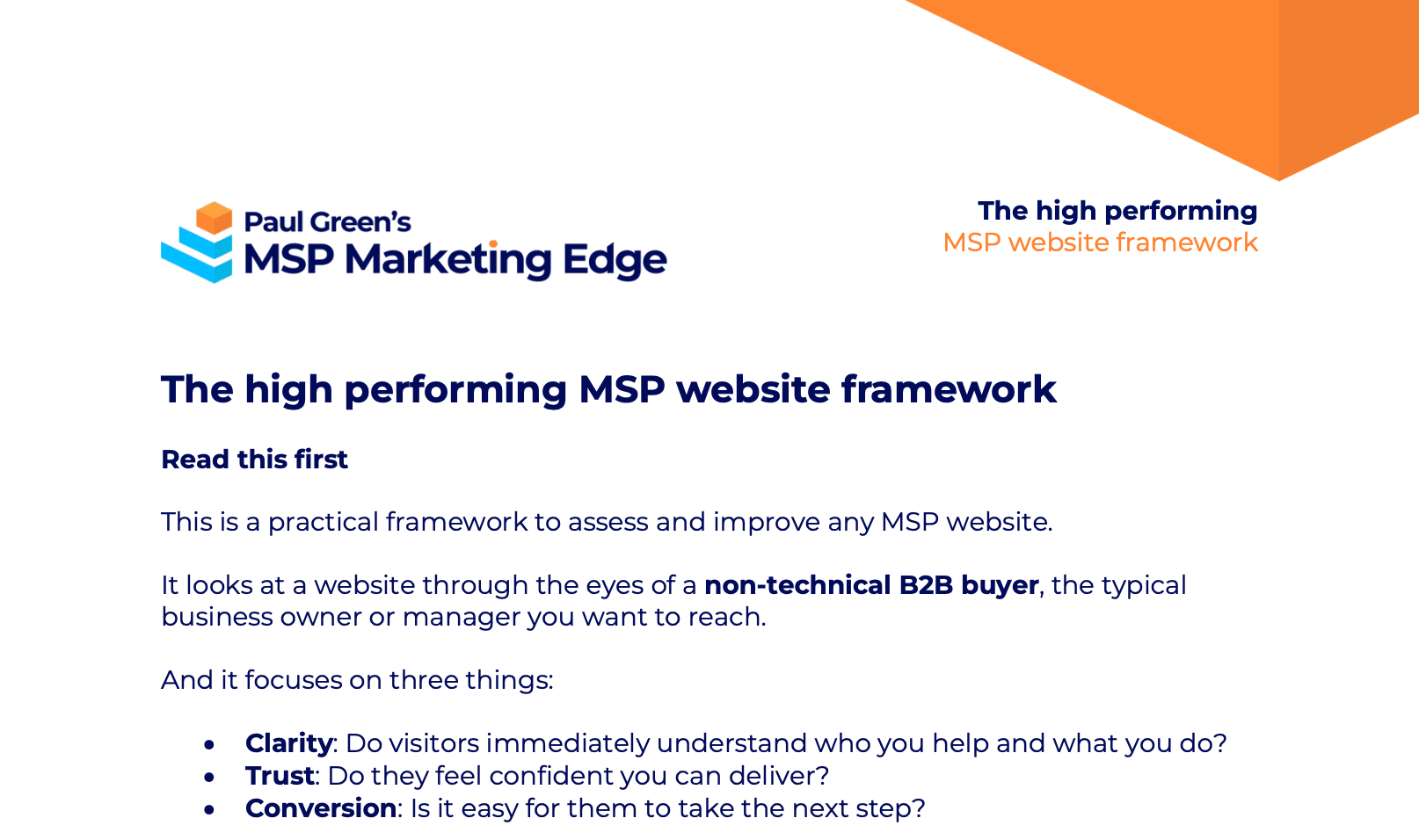
Earlier this year I revamped these reviews by building a powerful new framework.
It's called the high performing MSP website framework. And it helps me to look at every Site as if I was a non-technical business owner or manager thinking about switching MSPs.
The framework covers the whole site. But the most important part (that wins or loses the client before you’ve even spoken to them) is the homepage.
A strong MSP homepage has 10 essential blocks. Here they are.
Block 1: Clarity above the fold
The fold is the point where the visible screen ends and the visitor has to scroll. This is also known as the hero section. Within seconds of landing on your homepage, a prospect needs to understand three things:
- What you do
- Who you help
- What they should do next
If your headline says something like “Managed IT Services for Growing Businesses”... that tells them almost nothing. Instead you must talk directly to your ideal client and tell them why you're the perfect provider for them.
Prospects will stay on your website or leave it based just on the headline and everything else they see in the hero section.
Block 2: Problem recognition
Then, prospects need to feel “oh wow... these people understand my world”. And they need to feel it within the first scroll.
That means talking about their problems:
- Downtime
- Staff complaints about slow systems
- Security worries they don’t fully understand
- The feeling that their current IT company doesn’t really care about them
Don't talk about your solutions not yet. They don't care about your solutions at this stage. First you must engage them with empathy before you try to demonstrate expertise.
Block 3: Services overview
Here’s where most MSPs go wrong. They list features. “24/7 network monitoring.” “Help desk support.” “Security patching.”
Yawn. No ordinary business owner buying managed services cares about features. They care about outcomes.
There’s a simple formula I teach...
- Take any feature
- Add “which means” or “so that,”
- And finish with the outcome; what the client gains.
Feature: 24/7 network monitoring
Benefit: We spot and fix problems before your team even notices them, so your people can just get on with their work
Do that across your whole services section and it becomes a completely different read.
Block 4: Proof and credibility
Ordinary business owners and managers can't assess whether you’re technically good at the IT stuff. They don’t have the knowledge to do that because they're manufacturers, or lawyers, or whatever. But not IT professionals.
So instead they delegate the buying decision to their heart instead of their brain. which means they pick MSP based on how they feel about them.
And those feelings are most highly influenced by what your existing clients say. This is social proof and it's vital.
Testimonials, Google reviews pulled onto your site, and case studies.
Accreditations and certifications matter too, but they satisfy the brain rather than the heart. Social proof first, credentials second.
Block 5: Why choose us
This is where you reinforce your USP, your unique selling proposition. Why should they choose your MSP, specifically, rather than the 158 others they could find on Google?
And you need to give them a real answer. Not “we provide great service” or “we’re proactive and responsive.” Every MSP says those things. So they mean nothing.
Show them evidence. Tell them a story. Give them something specific they can hold onto.
Block 6: Human connection
For an ordinary business owner and manager, switching MSP is a distress purchase. They really would prefer not to switch even if that meant staying with an MSP they don't particularly like. Yes I know that's crazy but it helps to explain why your sales cycle is so slow, right?
When they do switch, they want to switch to people they LIKE. That means you need to show them the humans and help them connect with those humans. Yes I mean you and your team 😃
The more you can show the humans behind the business, the easier you make it for a prospect to pick you. Use photos of real people. Or better still a short video.
People buy from people. That has never been more true than it is right now, in an age where so much content feels like it was generated by a robot.
Block 7: Transparency on pricing
Think about your own buying behaviour. When you’re looking at something online, do you want to have to call someone just to find out if you can afford it?
Of course not. And neither do your prospects.
They must be able to access a rough idea of how much your MSP costs without having to contact you.
An interactive pricing calculator works brilliantly here. It gives them what they need and captures a lead at the same time. I created MSP Price Guide to help you fix this easily.
Block 8: Authority content
Your prospect doesn’t understand technology. So how do they judge whether you know your stuff?
By the content you produce. Articles, videos, guides that show you understand their world and have genuinely useful things to say about it.
Link to your best content from your homepage. A weekly blog. A YouTube video. A guide that answers a question they’re already asking.
One of the most used tools within my MSP Marketing Edge membership is a buyer's buide. We have versions for both our B2B and co-managed IT memberships.
This kind of content is how you demonstrate expertise to someone who can’t evaluate your technical skills directly.
Block 9: Lead capture
“Sign up for our newsletter” hasn’t worked for about 20 years. Nobody wants to get more emails.
What does work is an ethical bribe. Something genuinely useful you give to them in exchange for an email address. You can actually use the pricing calculator we were talking about earlier as a lead generation tool. A scorecard quiz also works well.
And make sure whatever you capture goes straight into your CRM and triggers a follow-up email sequence. Otherwise you're not collecting leads, you're just missing opportunities.
Block 10: A clear call to action
The next step the prospect should take must always be blindingly obvious.
I recommend a live calendar embedded in the page where they can book a 15 minute discovery call. Calendly or Microsoft Bookings both work well. Put it near the top of the page, again in the middle and at the bottom.
The easier you make it to take the next step, the more people will take it.
So... how does your homepage score?
Ten blocks. How many does your current homepage have in place? And are they in roughly that order???
Contact me and tell me your score. I read and reply to every email.
Get a free MP3 of my book MSP marketing: Start Here
when you join 8,000 other MSPs getting my weekly newsletter
Inside, I’ll reveal the four biggest obstacles blocking your lead generation and the simple 3 step system that overcomes them.
Buy it now on Audible.
Or in the next few minutes when you start getting my email newsletter.
Discover the marketing used by successful MSPs to generate leads & win clients
Every week I send out a FREE 5 min MSP marketing win. Smart ideas used by hundreds of MSPs to generate leads and close prospects.
Sent weekly on Fridays. Unsubscribe any time.