Paul Green
/
November 23, 2025
Get a free MP3 of my book MSP marketing: Start Here
when you join 8,000 other MSPs getting my weekly newsletter
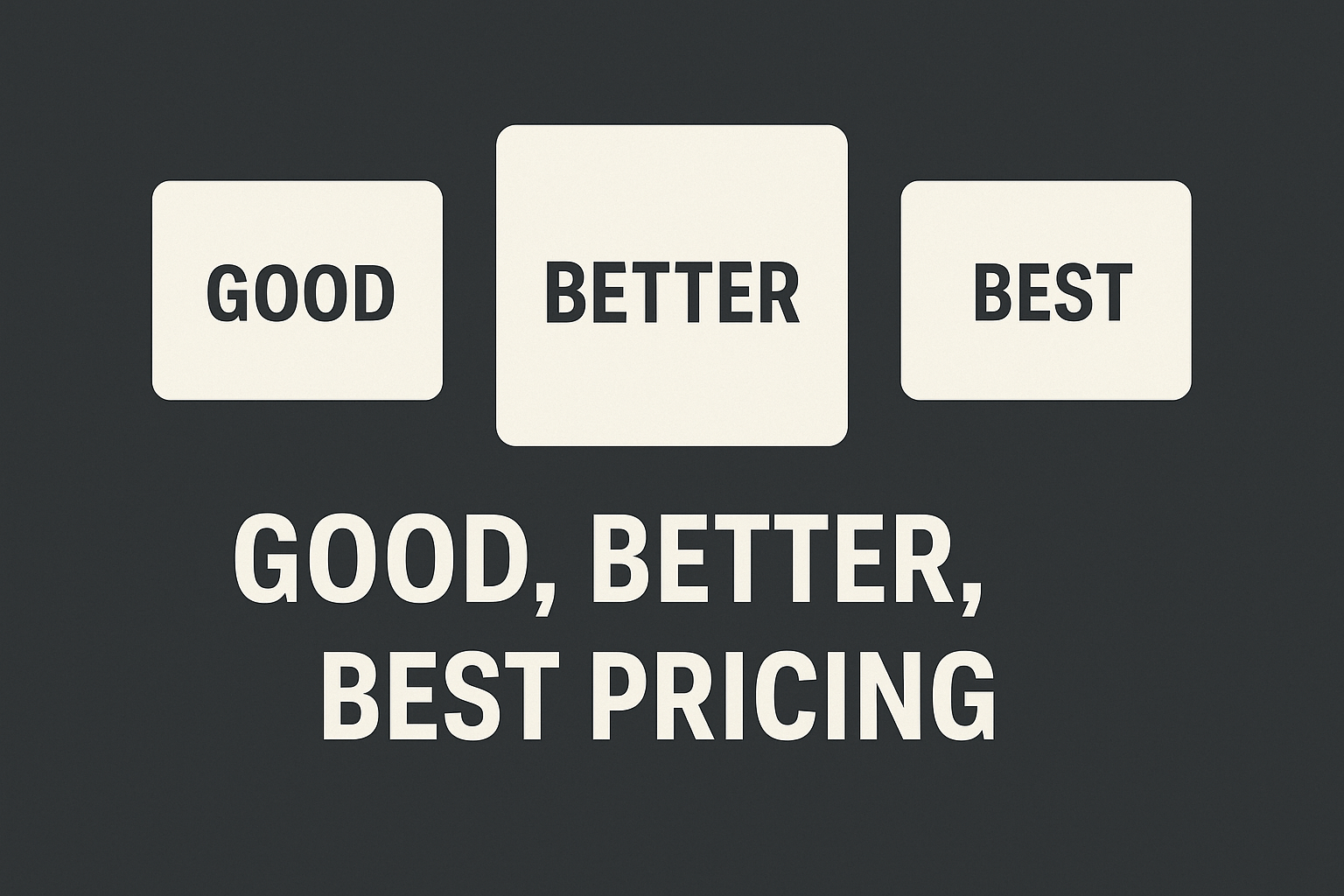
Do you offer 3 tier pricing to your prospects or do you just have one package (take it or leave it)? This subject is sometimes controversial with MSPs. Let's delve into the psychology that makes good, better, best pricing a smarter choice.
For some reason 3 tier pricing, also known as good, better, best pricing is controversial for some MSPs.
I hear comments like...
- "It's too complex," or
- "It adds noise to what's already a long sales process," or
- "Prospects will just get confused"
I believe this is focusing too much on the small number of downsides of good, better, best and completely overlooking the huge benefits.
Because done right, 3 tier pricing doesn’t complicate the sale... it guides it.
Let me show you why this works from a psychological point of view, how to structure it, and give you example packages you can adapt today.
First... what exactly is good, better, best?
You have a bundle of services or a package that you offer to your prospects. With good, better, best you still have that, but there are three different flavours of it.
The good package is just that. It's the essentials they need.
The better package is obviously... better. It has more services included and the price is higher to reflect that.
And the best package is the very best option you have. That will include everything at the highest price.
If I was to put names on this to help communicate it, they'd be something like...
- [good] Bronze = essential protection (keep the lights on)
- [better] Silver = business-grade resilience (most popular choice)
- [best] Gold = premium protection + strategy (for risk-averse / regulated firms)
You'll notice that the better choice (the silver package) is labelled as the most popular choice. Because a common way to use this is to put the package you most want to sell in the middle.
That way people can compare it. They can see something that's worse but less expensive. And something that's better but more expensive. It helps them feel as though they are picking the package that's right for them. That's a critical piece of buyer psychology (more on that in a second).
You know you've got good, better, best pricing correct when around three quarters of your sales sit within that middle package.
Why this works: The psychology (in plain English)
Here's something you might not know about me... I find the psychology of marketing one of the most interesting parts of my work (if you feel that way too, this book is a fantastic intro to marketing psychology).
A great deal of why we buy stuff is down to how we feel about it and what has motivated us to take action.
Fun fact: if aliens landed on Earth tomorrow, assuming their brains were wired differently to ours, then our human marketing wouldn't work to get them to buy stuff. That's something to bear in mind when we're establishing the first MSPs on Mars.
Anyway there are a few psychological principles at play here with the good, better, best packages. They include:
- Price anchoring: The top package sets a reference point so everything else feels more affordable
- Compromise effect: Most buyers avoid extremes and gravitate to the “middle” when you show three options. It feels safer to choose the middle option, especially if it's already been labelled as the most popular choice
- Choice architecture: You’re reducing the stress of making a decision by giving them a choice that's set within clear boundaries, and that appeal to people with different tolerances for risk. Plus of course different budgets
The net effect of this is...
- You don’t scare off price-sensitive buyers (bronze is the safe entry level)
- You unlock upsell for buyers who want more protection, faster response, or a stretegic approach (silver/gold)
- And the conversation becomes which package they choose... rather than whether or not they choose a package
Some ideas of how to structure your three tiers
Please don't think of these as my recommendation because that would be impossible to give without knowing your full tech stack and the way that your MSP is set up.
Instead, think of these as guidance... as a starting point for you to build your own packages...
Good / bronze
- Remote helpdesk during business hours
- RMM: Monitoring + patching
- AV/EDR baseline
- Basic backup (i.e. 365 only)
- SLA: standard response
Better / silver
- Everything in bronze PLUS...
- On-site visits included
- Full-server/workstation backup + tested recovery
- Email security + phishing defence
- SLA: priority response
- Annual strategic review
Best / gold
- Everything in silver PLUS...
- 24/7 response ( Jason Kemsley can help you with that )
- Advanced SOC + MDR
- vCIO/strategy, roadmap & budgeting
- Compliance reporting (depending on sector, of course)
Get a free MP3 of my book MSP marketing: Start Here
when you join 8,000 other MSPs getting my weekly newsletter
Inside, I’ll reveal the four biggest obstacles blocking your lead generation and the simple 3 step system that overcomes them.
Buy it now on Audible.
Or in the next few minutes when you start getting my email newsletter.
Discover the marketing used by successful MSPs to generate leads & win clients
Every week I send out a FREE 5 min MSP marketing win. Smart ideas used by hundreds of MSPs to generate leads and close prospects.
Sent weekly on Fridays. Unsubscribe any time.